Jeket is a set of Kubernetes-native media services connected by a shared-memory data plane and described by a single declarative graph. Here is what that actually means.
The Air Chain
Every chain is a Kubernetes Custom Resource. Sources, processing, graphics, analysis and egress are nodes on a graph; the operator reconciles the cluster until the graph is what is actually running. Design it in the editor, deploy it with kubectl, or generate it from your own tooling. The same file describes development, staging and air.
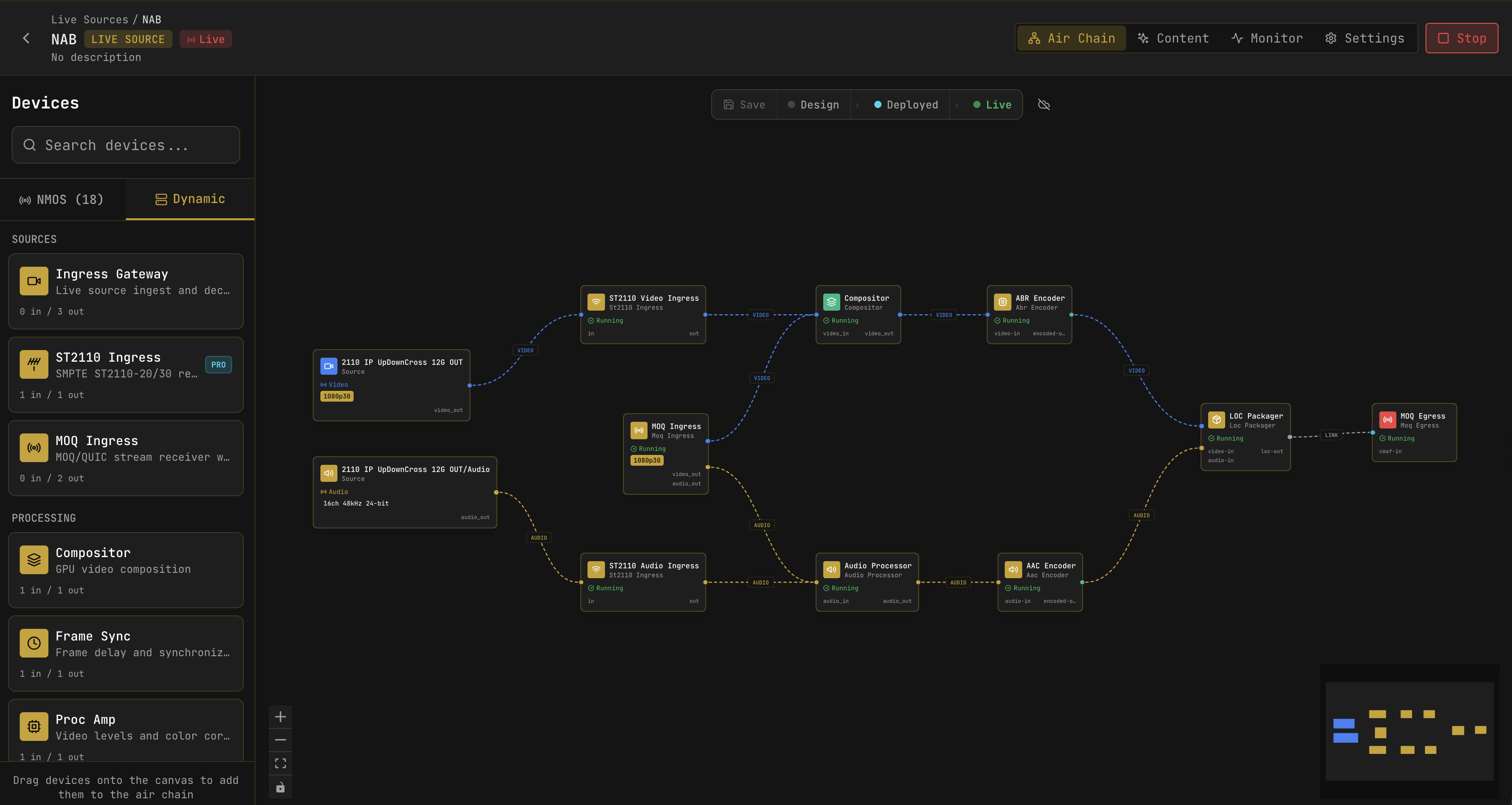
Because it is a resource, everything you already do to resources works: version it, review it, roll it back, template it per venue, and diff air against staging.
The data plane
Jeket is built on the Linux Foundation dmf-mxl SDK, the EBU Dynamic Media Facility Media eXchange Layer. Functions on the same host exchange media through shared memory; functions across hosts use RDMA. No serialisation, no copies, no format negotiation between stages.
Every stage in the chain reads the same buffer. Adding a processing step costs the processing, not another copy of the frame.
Cross-node exchange over libfabric, so a chain can span boxes without falling back to a network video protocol in the middle of your own pipeline.
Latency inside the pipeline is a function of the work you asked for, not of the plumbing between the stages doing it.
In and out
Come in at whatever level the room is at. The pipeline downstream of ingest is identical either way, so choosing SRT today costs you nothing when you want ST 2110 later.
What runs in the chain
Each function is its own service on the graph. Use the ones you need; the rest are not deployed and do not cost you anything.
Multi-layer compositing, a downstream keyer for bugs and lower thirds, and a rendering service for animated graphics.
Video switching with frame synchronisation across sources, plus audio mixing and processing that stays in sync through it.
SCTE-driven break insertion and return, with markers carried downstream so packaging knows where the opportunities are.
Continuous inference on the picture and the sound. Analysis is emitted as events other services and your own systems can subscribe to.
Loudness measured against target on every programme path, with silence and level faults raised as events rather than discovered later.
Live captions with word-level timing, carried as timed text through the pipeline and out to every egress that can take them.
Deployment
The platform scales from a single box on a desk to a multi-node cluster across a facility. It is the same code, the same graph and the same APIs at both ends, and capability is discovered from the hardware rather than sold as a tier. A node with the right NIC does ST 2110; a node without one does everything else.
Deploy on-prem with zero-touch Kubernetes on bare metal, hybrid with cloud-extended distribution, or fully cloud-native. Your infrastructure, your network, your data.
Hardware
The reference deployment is a single NVIDIA DGX Spark, and that box runs the same software as the cluster it may one day be part of.